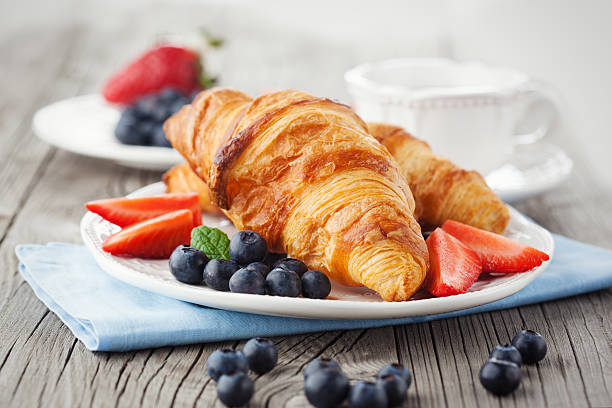
The Architecture of Perfect Puff Pastry: Croissant Mastery
Referred to by many pastry chefs as the Mount Everest of baking, the classic French croissant relies on a highly technical process known as lamination. This technique involves folding butter into dough multiple times to create hundreds of alternating microscopic layers of fat and dough. When exposed to the intense heat of an oven, the water content within the butter rapidly turns to steam. This sudden burst of vapor forces the dough layers apart, creating the iconic, shatteringly crisp honeycomb interior—a phenomenon known as mechanical leavening.
The Science of the Détrempe and Beurrage
The foundation of any exceptional puff pastry begins with the détrempe (the base dough) and the beurrage (the butter block). The absolute critical factor here is matching the consistency and plasticity of both components. If the butter is too cold, it will fracture and shatter during the rolling process, tearing through the delicate gluten network of the dough. Conversely, if the butter is too warm, it will melt and absorb directly into the flour, resulting in a dense, brioche-like bread rather than a flaky pastry.
- Gluten Development: The détrempe must be kneaded just enough to develop a strong gluten network capable of stretching without tearing, but not so much that it becomes dangerously elastic and resists rolling.
- Butter Plasticity: Professional bakers utilize high-fat European butter (minimum 82% butterfat) because its lower water content makes it more pliable at cooler temperatures, typically maintaining optimal plasticity around 14°C to 16°C (57°F to 60°F).
- The Tourage Process: Executing the folds (typically a combination of single and double turns) requires a chilled environment. Resting the dough in the refrigerator between turns is non-negotiable, as it relaxes the gluten and re-chills the butter, preventing layer amalgamation.
Mastering the Proofing Stage
Even with perfect lamination, improper proofing can ruin a croissant. The shaped pastries must proof in an environment that is warm enough to activate the yeast but cool enough to prevent the butter from melting. The absolute maximum proofing temperature is 27°C (80°F). Exceeding this threshold will cause the butter layers to liquefy and pool on the baking sheet, leading to a heavy, greasy final product with a collapsed internal structure.

Crème Brûlée Science: Eradicating the Honeycomb Texture
Transitioning from the structural complexity of laminated dough to the delicate biochemistry of custards, crème brûlée presents its own unique set of scientific challenges. The ultimate hallmark of a flawless crème brûlée is a velvety, completely homogenous interior that yields a gentle “wobble” or shake when nudged. However, many bakers fall victim to the dreaded honeycomb texture—a spongy, grainy, and weeping custard filled with tiny air pockets.
The Biochemistry of Protein Coagulation
The honeycomb texture is strictly a symptom of thermal abuse. Crème brûlée is a delicate emulsion of egg yolks, heavy cream, and sugar. Egg yolk proteins begin to denature and coagulate (thicken) at approximately 71°C (160°F). When the custard is baked perfectly, these proteins form a loose, microscopic mesh that traps the liquid cream, resulting in a smooth gel.
If the internal temperature of the custard exceeds 82°C (180°F), the proteins over-coagulate. They bond too tightly together, aggressively squeezing out the trapped liquid in a chemical process known as syneresis. Simultaneously, the liquid begins to simmer, creating tiny steam bubbles that get permanently trapped in the rapidly hardening protein matrix. This dual disaster of syneresis and trapped steam is exactly what creates the rubbery, honeycomb-like structure.
The Crucial Role of the Bain-Marie
To prevent overcooking, French culinary tradition relies on the bain-marie, or water bath. By placing the ramekins in a roasting pan filled with boiling water, bakers manipulate the laws of thermodynamics to protect the delicate custard.
- Thermal Buffering: Water cannot exceed 100°C (212°F) at sea level. The water bath acts as a thermal insulator, ensuring the exterior of the ramekins never reaches the harsh 150°C (300°F) ambient temperature of the oven.
- Even Heat Distribution: The water transfers gentle, radiant heat evenly across the sides and bottom of the ramekins, ensuring the edges do not curdle before the center sets.
- The Visual Cue: The custard is ready to be removed from the oven when the edges are set but the center inch still jiggles like gelatin. Residual heat will gently finish cooking the center as it cools at room temperature.

Essential Temperature Dynamics in Classic French Desserts
While croissants and crème brûlée sit on opposite ends of the textural spectrum—one shattering and airy, the other dense and creamy—they share a fundamental reliance on rigorous temperature control. In French baking, ingredients are merely the actors; temperature is the director that dictates how they perform on the culinary stage.
Comparative Analysis of Thermal Requirements
Understanding the contrasting thermal environments required for these two masterpieces highlights the versatility required of a pastry chef. For puff pastry, the goal is to delay fat melting until the absolute last second in the oven. For crème brûlée, the goal is to elevate the temperature of the proteins so slowly that they never experience thermal shock.
| Baking Parameter | French Croissants (Puff Pastry) | Crème Brûlée (Baked Custard) |
|---|---|---|
| Preparation Temp | Strictly Cold (14°C – 16°C) to maintain butter plasticity. | Warm (Cream steeped and tempered into yolks). |
| Baking Environment | High Heat (200°C / 400°F) for rapid steam expansion. | Low Heat (150°C / 300°F) with a protective water bath. |
| Failure Mechanism | Butter melts before baking; loss of lamination. | Proteins over-coagulate; honeycomb texture forms. |
| Cooling Protocol | Room temperature on a wire rack to preserve crispness. | Chilled for a minimum of 4 hours to set the fat and proteins. |
By treating your kitchen as a laboratory and respecting these precise thermal boundaries, you eliminate the guesswork from French baking. Precision scales, instant-read thermometers, and an understanding of ingredient behavior under thermal stress are the true secrets to replicating Parisian-quality pastries in a home kitchen.
Frequently Asked Questions (FAQ)
- Why is my puff pastry shrinking when I bake it?
- Shrinkage in puff pastry is primarily caused by insufficient resting times between the tourage (folding) stages. When the dough is rolled, the gluten network becomes tense and elastic. If you do not allow the dough to rest in the refrigerator for at least 30 to 45 minutes before baking, the activated gluten will violently snap back to its original shape when exposed to oven heat.
- Can I salvage a crème brûlée that has developed a honeycomb texture?
- Unfortunately, once the egg proteins have over-coagulated and syneresis has occurred, the chemical change is irreversible. The custard cannot be made smooth again. To prevent this in the future, ensure you are using a proper water bath, monitor the oven temperature with an independent thermometer, and pull the ramekins out when the center still has a distinct wobble.
- Why do my croissants taste like bread instead of flaky pastry?
- This is the classic result of the butter melting into the détrempe during the lamination process. This usually happens if the ambient room temperature is too warm, the dough wasn’t chilled sufficiently between folds, or the proofing environment exceeded 27°C (80°F). When the butter incorporates into the dough rather than remaining as distinct layers, you lose the mechanical leavening effect, resulting in a dense, bread-like crumb.
- Do I have to use a water bath for crème brûlée if my oven runs cold?
- Yes, the water bath is absolutely mandatory regardless of your oven’s baseline temperature. Air is a poor conductor of heat and causes rapid, uneven temperature spikes on the surface of the ramekin. Water is a highly efficient conductor that surrounds the custard with a gentle, maximum-capped temperature (100°C/212°F), ensuring the delicate egg yolks cook evenly from edge to center without curdling.